The short version
Math is the make-or-break subject in homeschool. Almost every homeschool failure I hear about traces back to math — kids sliding forward grade by grade without ever building real fluency, then hitting algebra and falling apart. The curriculum question is not which program looks the most beautiful. It is how the program handles the gap between understanding a concept and being fluent in it.
That narrows the field of "best homeschool math curriculum" from hundreds of options to about seven that matter, and the right one depends on your kid and how much time you can give it.
What to look for
- Mastery before motion — the program does not advance until your child has demonstrated fluency, not just completed the page
- A clear path from concept to procedure — concrete (manipulatives or visual models) → pictorial → abstract notation, in that order
- Spiral review built in — prior material reappears constantly, because math fluency decays without it
- Word problems that aren't trivial — if every problem can be solved by spotting the keyword, the program is teaching pattern-matching, not math
- A parent-prep level you can actually sustain — the best curriculum is the one you will actually run every day, not the one with the prettiest reviews
Mastery vs. spiral: the first big choice
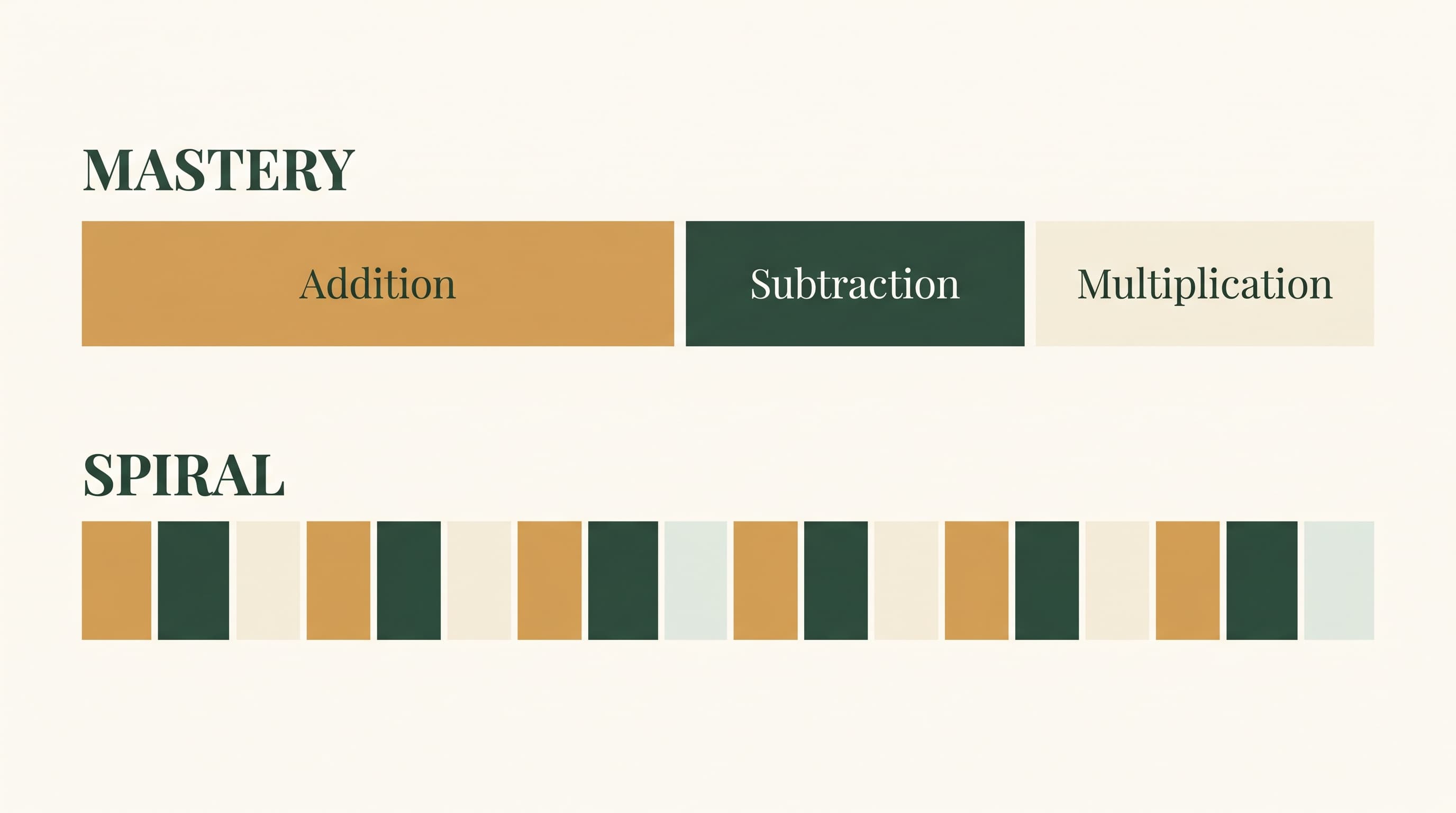
Almost every conversation about homeschool math eventually splits along this axis. Mastery programs (Math-U-See, Math Mammoth, Singapore) teach one concept at a time and don't move on until your child has it. Spiral programs (Saxon, Horizons) cycle through every concept over and over, mixing review with new material every day.
Mastery is cleaner conceptually — your child finishes addition before starting subtraction. But mastery without spiral review tends to forget. A child who mastered fractions in October can stare blankly at one in March. Spiral is harder to follow as a parent— every lesson is a mix of unrelated topics — but it's what produces durable fluency over years.
The honest answer is most homeschoolers do best with mastery + a small spiral review component. Singapore + ten minutes of mental-math drills daily. Math Mammoth (which has built-in mixed review). Math-U-See followed by Saxon when fluency starts slipping. The all-mastery and all-spiral camps are both wrong. Pick a primary program, then add the missing half deliberately.
Conceptual vs. procedural: the second big choice
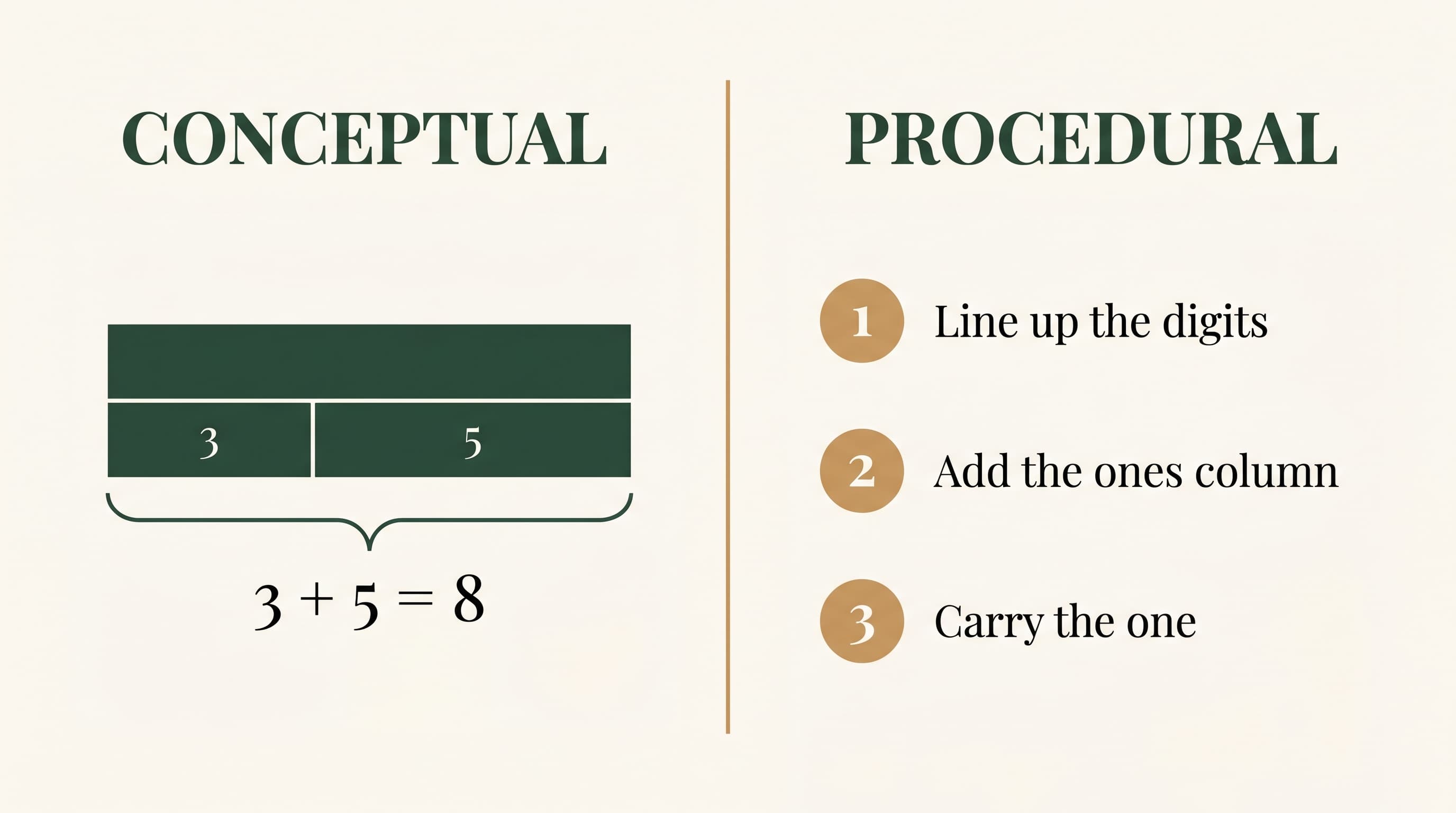
The other axis. Some programs (Singapore, Beast Academy, RightStart) teach whythe math works — the conceptual model — before the procedure. Others (Saxon, Teaching Textbooks) lead with the procedure and let understanding catch up. Both can produce kids who get the right answer. Only the first reliably produces kids who can solve a problem they've never seen.
If your child might end up in a STEM track — engineering, physics, computer science, math team — bias hard toward conceptual depth. The kids who hit a wall in algebra and never recover are usually kids whose elementary math was procedural-only. They could compute but they couldn't reason. Once the math gets abstract, computation isn't enough.
For a kid who's aiming at, say, a humanities track or just needs solid practical math, procedural-first is fine and often less stressful for both of you. Just don't let "solid practical math" mean "memorized worksheets they'll forget by 8th grade."
Programs covered in this guide
The 7 programs that actually work
Drawn from the Harmony database of 1,307 scored curricula. Each has a real reason to exist; each has a real reason it's wrong for some kids.
Saxon Math
Rigorous, spiral, and cheap. The workhorse of homeschool math for forty years for a reason — kids who finish it tend to test well and have real procedural fluency.
- Best for
- Disciplined kids and parents
- Test prep and procedural fluency
- Budget-conscious families
- Independent older students (5th grade+)
- Approach
- Spiral. Continuous review of all prior material in every lesson.
- Cost
- $80-150 per level, often available used.
- Ages
- K-12 (Saxon K-3 is widely skipped — start at Saxon 5/4 for a 4th grader)
- Parent prep
- Low. Scripted, worksheet-heavy, can be largely independent by middle elementary.
Pros
- Proven over 40 years of homeschool use
- Strong test-prep outcomes (SAT/ACT math)
- Cheap and reusable across siblings
- Minimal parent involvement once established
Cons
- Repetitive and explanation-light
- Conceptually thin compared to Singapore
- Boring for kids who need to see the why
- Can drill without building real understanding
Singapore Math (Primary Mathematics or Dimensions)
The gold standard for conceptual depth. Bar models, mental math, and a deliberate concrete → pictorial → abstract progression that builds genuine number sense.
- Best for
- Conceptual learners
- STEM-track kids
- Parents willing to teach (not just supervise)
- Families wanting maximum mathematical depth
- Approach
- Mastery. Bar-model problem solving from grade 1 onward.
- Cost
- $80-130 per level new; Dimensions edition is the modern US-friendlier version.
- Ages
- K-8 (high school: pair with AOPS or Math Without Borders)
- Parent prep
- Medium-high. You teach the lesson; the workbook reinforces it.
Pros
- Best conceptual foundation of any mainstream program
- Bar models transfer beautifully to algebra later
- World-class word problems
- Mental math is unusually strong
Cons
- Requires actual teacher prep, not just worksheet handoff
- Light on built-in review — needs spiral supplements
- Multiple editions can confuse buyers (Primary Mathematics 2022, Dimensions, US Edition)
- Stops at grade 8; need a different high-school plan
Math-U-See
Manipulative-heavy and scripted enough that a non-math-confident parent can teach it. Every concept is taught with the integer block set before any worksheet appears.
- Best for
- Hands-on / kinesthetic learners
- Parents who don't feel confident teaching math
- Visual learners
- Kids with dyslexia or processing differences
- Approach
- Mastery. Sequenced by topic (place value, then addition, etc.) rather than by grade.
- Cost
- $50-80 per level + ~$50 one-time manipulative set.
- Ages
- K-12 (Primer through Calculus)
- Parent prep
- Low-medium. Lesson videos do most of the teaching work.
Pros
- Manipulatives make abstract concepts concrete
- Scripted lesson videos teach the parent and the kid
- Forgiving for non-math-confident parents
- Strong for kids with learning differences
Cons
- Topical sequencing can leave gaps if you switch in
- Considered conceptually thinner than Singapore
- Less spiral review than Saxon
- Word problems are weaker than the strongest programs
RightStart Math
Visual, abacus-based, and unusually effective for early grades. Kids learn to subitize and do mental math in ways that pay dividends for years.
- Best for
- Strong K-3 foundation building
- Parents with time to teach every lesson
- One-on-one or small-group homeschools
- Kids who need a non-worksheet approach early
- Approach
- Mastery. Abacus-based, game-heavy, teacher-led.
- Cost
- $120-180 per level + ~$200 one-time manipulative kit.
- Ages
- K-8 (strongest in K-4)
- Parent prep
- High. Every lesson is a teacher-led activity; not an independent worksheet.
Pros
- Best mental-math foundation of any program
- Subitizing and place-value work is exceptional
- Games and activities keep young kids engaged
- Pays dividends in algebra-readiness
Cons
- Highest parent-prep burden on this list
- Will break a stretched parent running multiple kids
- Materials cost is front-loaded
- Less recognized by colleges than Saxon/Singapore
Beast Academy → Art of Problem Solving (AOPS)
For a kid who is fast at math and hungry for harder problems. Beast Academy teaches in comic-book form but the math is genuinely challenging — closer to a math-team training program than a standard curriculum.
- Best for
- Gifted and accelerated learners
- Kids aiming at math competitions or STEM track
- Self-driven problem-solvers
- Future MIT / Caltech aspirants
- Approach
- Mastery + problem-solving focus. Heavy on novel problems vs. drill.
- Cost
- Beast Academy: $80-110/level. AOPS Online courses: $400-500 each.
- Ages
- Beast Academy: 2-5. AOPS: 6-12.
- Parent prep
- Low. Kid-led; the curriculum does the heavy lifting.
Pros
- Genuinely hard math, not dressed-up drill
- Comic-book format engages reluctant kids
- Direct pipeline to math team / MIT-level prep
- AOPS is the de facto pre-college math standard for STEM
Cons
- Overkill for an average learner
- Can frustrate kids who aren't already strong at math
- AOPS Online is expensive
- Light on procedural drill — pair with Khan Academy if needed
Teaching Textbooks
Computer-based, mastery-paced, and the easiest program to run when the parent is stretched thin. The software teaches and grades; the kid works mostly independently.
- Best for
- Busy or working parents
- Independent learners
- Kids on a non-STEM track
- Families with multiple kids needing parent-light options
- Approach
- Mastery, computer-led. Self-paced video lessons + auto-grading.
- Cost
- $70-120 per level (annual subscription).
- Ages
- 3-12 (Math 3 through Pre-Calculus)
- Parent prep
- Minimal. The computer does the teaching.
Pros
- Hands-off for the parent — runs itself
- Auto-grading saves hours per week
- Kids genuinely enjoy it
- Good for a homeschool with multiple subjects to juggle
Cons
- Widely considered ~1 grade level behind Saxon/Singapore in rigor
- Risky for STEM-bound kids hitting algebra and beyond
- Conceptual depth is the weakest of the seven listed here
- Subscription model means no resale value
Math Mammoth
The best value on this list. Affordable PDF curriculum, mastery-with-spiral-review hybrid, written by a math teacher who clearly cares about why the math works.
- Best for
- Budget-conscious families
- Singapore-style approach without the shopping headache
- Self-directed parents who can teach without a script
- Multi-kid families wanting a reusable PDF
- Approach
- Mastery + built-in spiral review.
- Cost
- $40-50 per grade as a PDF. Light Blue series is the all-in-one core.
- Ages
- K-8
- Parent prep
- Medium. Light teaching guide; mostly self-directed once explained.
Pros
- Cheapest credible program on this list
- Singapore-style conceptual approach
- Built-in spiral review (rare for mastery programs)
- Reusable PDF across siblings forever
Cons
- Layout is denser than glossier programs
- Less teacher hand-holding than Math-U-See
- Stops at grade 8
- No companion video lessons by default
Skip the research — get math-curriculum picks in 5 minutes.
See your math match →Quick comparison: all seven, side by side
The seven programs above, scored on the four trade-offs that actually matter when you're running a school day.
| Program | Approach | Parent prep | Conceptual depth | Cost / level | Best for |
|---|---|---|---|---|---|
| Saxon | Spiral | Low | Medium | $80-150 | Disciplined kids, test prep |
| Singapore | Mastery | Medium-high | High | $80-130 | Conceptual learners, STEM track |
| Math-U-See | Mastery | Low-medium | Medium | $50-80 + manip. | Visual / hands-on kids |
| RightStart | Mastery | High | Very high | $120-180 + kit | Strong K-3 foundation |
| Beast Academy / AOPS | Mastery + problem-solving | Low (kid-led) | Highest | $80-110 / $400+ | Gifted, competition track |
| Teaching Textbooks | Mastery (computer-led) | Minimal | Lower | $70-120 | Busy parents, non-STEM kids |
| Math Mammoth | Mastery + spiral review | Medium | High | $40-50 | Budget-conscious families |
What to avoid
- "Living math" or literature-based math as your only program — read-alouds about math are great, but they don't build fluency
- Curricula that swap mastery for novelty (a new theme or game every week, no consistent practice loop)
- Sliding kids forward by grade level on the cover without proving fluency at each stage — the single most common cause of homeschool math collapse around 6th-8th grade
- Anything that promises "painless" math. Math is not painless. A program that pretends otherwise is hiding the actual practice somewhere your child is not doing it.
When to switch math curriculum
Switching mid-year feels like failure. It usually isn't. The signs you should switch are clearer than the signs you should stay:
- Tears at the math table for more than two weeks running. Not bad days — sustained dread. The curriculum is wrong for this kid.
- Right answers without understanding. Quiz them: "Why does the borrow work?" If they shrug, the program is teaching procedure without concept and you'll pay for it in algebra.
- You're bored teaching it. Honestly. If the lessons feel pointless to you, your kid is feeling that too.
- It's six months in and you've fallen a third of the way behind. The pace is wrong. Either the program assumes prior knowledge they don't have, or it's pitched at a level above them. Drop a grade or switch programs.
What's NOT a sign to switch: a single bad week, a chapter that's harder than the last one, a kid who liked math and now temporarily doesn't. Math gets harder; that's the point. The bar is sustained mismatch, not normal struggle.
When you do switch, drop a grade level on the new program for the first month. New curricula present concepts differently — Singapore's bar models look nothing like Saxon's box-and-line problem setup — and your kid needs a runway to learn the new visual vocabulary before tackling new material.
Teaching math when you're not a math person
Roughly half the parents we've talked to think they're "not a math person." Most of them are wrong — they had a bad teacher in 7th grade and have flinched ever since. But operationally, here's what works for someone who doesn't feel confident:
- Pick a scripted program. Math-U-See and Saxon are both scripted enough that you read what to say. RightStart is too — though more demanding. Avoid Singapore Primary Mathematics if you don't feel comfortable improvising the lesson; the textbook is dense and parent-driven.
- Watch the lesson video first, alone, the night before. Math-U-See and Teaching Textbooks both have lesson videos. Watch them once at 1.5x. If you understand it, you can teach it.
- It's OK to say "I don't remember, let's figure it out together." Modeling problem-solving is more valuable than performing certainty. A kid who watches their parent puzzle through a problem learns more than one who watches their parent rattle off the answer.
- By 6th-7th grade, hand it off. Teaching Textbooks, AOPS Online, Math Without Borders — there are programs designed to teach without you. Use them. Your relationship with your kid is more important than your performance as their math teacher when they're 12.
Variations of this question
The right math curriculum changes when the kid changes. These are the variants we get asked about most.
Math curriculum for kindergarten →
RightStart A, Singapore Earlybird, Math-U-See Primer — what works at 5 and 6 vs. what to skip.
Math curriculum for middle school →
The pre-algebra inflection point. Where most kids hit a wall and how to avoid it.
Math curriculum for high school →
AOPS, Math Without Borders, Derek Owens, Teaching Textbooks — high-school paths ranked.
Math curriculum for dyslexia →
Visual, manipulative-heavy programs that don't rely on heavy reading.
Math curriculum for ADHD →
Short lessons, low-overwhelm pacing, programs that won't punish a wandering attention span.
Math curriculum for gifted learners →
Beast Academy → AOPS, Singapore on accelerated pacing, math-team-style problem sets.
Math curriculum for kids behind grade level →
How to drop back without humiliation and rebuild fluency from where it actually broke.
Secular math curriculum →
Math is mostly secular by default — but here are the programs that won't slip in worldview content.
Skip the research — get math-curriculum picks in 5 minutes.
Get matched in 5 minutes →Common questions
What is the best homeschool math curriculum?
There is no single best — the right pick depends on your child and how much time you can spend teaching. For a parent-light, computer-based path: Teaching Textbooks. For rigor on a budget: Saxon Math or Math Mammoth. For conceptual depth with visual models: Singapore (Primary Mathematics or Dimensions). For a kid who needs manipulatives: Math-U-See or RightStart. For a gifted problem-solver: Beast Academy and then AOPS.
Is Saxon Math good for homeschoolers?
Yes, for the right kid. Saxon is rigorous, spiral (constant review of prior material), and proven over decades. It is cheap, it is thorough, and kids who finish it tend to test well. The downside is that it is repetitive and explanation-light — a child who needs to see why the math works before drilling it can find Saxon dry. Pair it with Singapore for conceptual depth, or skip it for a kid who hates worksheets.
What about Teaching Textbooks for homeschool math?
Teaching Textbooks is the easiest program to run as a busy parent — the computer teaches and grades, your child works mostly independently. That is its strength and its weakness. It is mastery-based and accessible, but it is widely considered about a grade level behind Saxon or Singapore in conceptual depth. Fine for a kid who is not heading toward STEM. Risky as the only math your child sees if they might need to take real algebra and calculus later.
How do I know if my child is actually learning math?
Don't trust grade level on the cover. Trust fluency. Can your child do the four operations without counting on fingers? Can they solve a word problem they have not seen the exact form of before? Can they explain why a procedure works, not just execute it? If yes, the curriculum is working. If not — even if they are getting answers right on the worksheet — something is being skipped. Most homeschool math failures trace back to sliding kids forward by grade without proving fluency at each stage.
When should I switch math curriculum?
Real signs to switch: tears at the math table for more than two weeks running, right answers without understanding when you spot-check, you're bored teaching it, or you've fallen a third of the way behind by month six. Not signs to switch: one bad week, a hard chapter, a kid who temporarily doesn't enjoy it. When you do switch, drop one grade level on the new program for the first month so your child can learn the new visual vocabulary before tackling new material.
Can I use Khan Academy as my main math curriculum?
Possible, but not recommended as the only program below high school. Khan is excellent supplemental practice and excellent for high school review or self-paced acceleration. As a primary K-6 curriculum it has gaps in scope and sequence — it's organized around the standards it covers, not around how kids actually build math fluency in order. Pair it with a structured primary program (Math Mammoth, Singapore, or Saxon) rather than relying on it alone.
Singapore Math vs Saxon — which is better for a STEM-bound kid?
Singapore. Saxon produces strong test takers and procedurally fluent kids; Singapore produces kids who understand the why and can solve problems they haven't seen before. Saxon-only kids often hit a wall in algebra when problems require reasoning rather than recall. Singapore-only kids occasionally need spiral-review supplements (mental-math drills, an inexpensive review workbook) to maintain procedural fluency, but the conceptual foundation is the harder thing to backfill later.
What is mastery vs spiral math, and which is better?
Mastery programs (Singapore, Math-U-See, Math Mammoth) teach one concept at a time and don't move on until your child has it. Spiral programs (Saxon, Horizons) cycle through every concept repeatedly, mixing review with new material every day. Mastery is cleaner conceptually but tends to forget. Spiral produces durable fluency but is harder to follow as a parent. Most homeschoolers do best with mastery + a small spiral component (e.g., Singapore plus 10 minutes of mental-math drill daily).
How much does homeschool math curriculum cost?
Wide range. Math Mammoth is the cheapest of the credible options — roughly $40-50 per grade as a PDF. Saxon runs $80-150 per level used. Singapore Primary Mathematics or Dimensions runs $80-130 per level new. Math-U-See runs $50-80 per level plus a one-time ~$50 manipulative set. Teaching Textbooks runs $70-120 per level (subscription). RightStart runs $120-180 per level plus a one-time ~$200 manipulative kit. Beast Academy runs $80-110 per level. AOPS Online courses run $400-500 per course. Reusable materials across siblings make most of these effectively much cheaper over years.
What's the best homeschool math curriculum for kindergarten?
RightStart Math A is the strongest K curriculum if you have time to teacher-lead every lesson. Singapore Earlybird and Math-U-See Primer are gentler on parent prep. Math Mammoth Light Blue Grade 1 (which can start late K) is the budget pick. Avoid heavy worksheet curricula at this age — at 5 and 6 you want manipulatives, games, and number sense, not pencil-and-paper drill.
What's the best homeschool math curriculum for high school?
Three good paths. (1) AOPS Online (Algebra, Geometry, Intermediate Algebra, Pre-Calculus, Calculus) — the gold standard for STEM-bound kids who can handle hard problems. (2) Math Without Borders or Derek Owens — video-based, instructor-led, great for parents handing math off. (3) Teaching Textbooks Algebra → Geometry → Pre-Calculus — easiest to run, lower rigor, fine for non-STEM. Saxon Algebra/Geometry remains a reasonable lower-cost option for procedural fluency. Avoid trying to teach high school math from a generic textbook with no support — the failure rate is high and the recovery is painful.
Singapore vs Math-U-See — which is better for a hands-on learner?
Math-U-See. The integer block set is central to every lesson and the program is built around manipulating concrete objects before any abstract notation appears. Singapore uses bar models (a visual representation) but they're drawn on paper, not handled physically. For a kid who needs to touch the math, Math-U-See is the right call. For a kid who can hold visual models in their head, Singapore goes deeper conceptually.
Is Math Mammoth as good as Singapore?
Almost. Math Mammoth borrows heavily from Singapore's conceptual approach (bar-model-style problem-solving, mastery sequencing) but adds built-in spiral review and is dramatically cheaper. It's slightly less elegant pedagogically and the layout is denser, but the content is rigorous and well-sequenced. For a budget-conscious family who wants Singapore-quality math without the Singapore-edition shopping headache, Math Mammoth is the right answer.
How do I teach math if I'm not good at math?
Pick a scripted program (Math-U-See, Saxon, RightStart). Watch the lesson video before you teach — Math-U-See and Teaching Textbooks both have lesson videos; watch them at 1.5x the night before. It's OK to say 'I don't remember, let's figure it out together' — modeling problem-solving beats performing certainty. By 6th-7th grade, hand it off: Teaching Textbooks, AOPS Online, or Math Without Borders can teach without you. Your relationship with your kid matters more than your performance as their math teacher when they're 12.
Is Beast Academy too hard for an average kid?
Often, yes. Beast Academy is designed for kids who are already comfortable with grade-level math and want harder problems. An average learner can hit a wall in the harder chapters and lose confidence. Better default for an average kid: Singapore (conceptual depth without the difficulty spike) or Saxon (procedurally rigorous without the novel-problem load). Save Beast Academy for the kid who finishes math early and asks for harder problems unprompted.
What's the best homeschool math curriculum for 1st-3rd grade?
RightStart Math (if you have time to teacher-lead every day) is the strongest foundation. Math-U-See is the easier-to-run mastery alternative with manipulatives. Singapore Earlybird → Primary Mathematics 1A is the conceptual gold standard. Math Mammoth Light Blue 1-3 is the budget pick that doesn't sacrifice rigor. Avoid worksheet-heavy programs at this age — early elementary is where number sense and place-value intuition get built, and that requires manipulating concrete objects.
What's the best homeschool math curriculum for 4th-6th grade?
This is where the Singapore vs Saxon split sharpens. For STEM-bound kids: Singapore Primary Mathematics or Beast Academy 4-5. For procedural fluency without the parent-teaching load: Saxon 5/4 → 6/5 → 7/6. For families wanting parent-light: Teaching Textbooks 4-6 (with the caveat that it's about a grade behind on rigor). Math Mammoth 4-6 is the budget pick that holds rigor.
How do I switch from Saxon to Singapore mid-year?
Drop a grade level. Singapore's bar models look nothing like Saxon's box-and-line problem setup, and your kid needs a runway to learn the new visual vocabulary before tackling new content. Spend the first month of the new program on review-level material — let them experience early wins on familiar topics taught the new way. Singapore is also more parent-driven than Saxon was, so plan for ~20 minutes more daily teaching prep. Most families who make this switch are happy by month two.
What manipulatives do I need for homeschool math?
Depends on the program. Math-U-See requires its integer block set (~$50, one-time purchase, reusable across years and siblings). RightStart requires its abacus + AL kit (~$200, also reusable). Singapore doesn't require manipulatives but benefits from base-ten blocks and a simple balance scale. Saxon and Math Mammoth require essentially nothing beyond a pencil. For K-3 generally, having base-ten blocks, two-color counters, and a 100-bead abacus on hand is worth the ~$50 even if your program doesn't require them.
Is RightStart Math worth the cost?
If you have one or two young kids and at least 30 focused minutes per day to teacher-lead the lesson — yes, it's the strongest K-3 foundation you can buy. If you're stretched across 4 kids and 5 subjects, no — it'll break you and you'll quit. The materials cost (~$200 starter kit + $120-180/level) is reasonable when amortized across multiple kids. The time cost is the real expense.
Can I combine multiple math curricula?
Yes — and most successful homeschoolers do. Common stacks: Singapore (concept) + Saxon mental-math drills (fluency). Math-U-See (manipulative-led) + Beast Academy puzzles (problem-solving). Teaching Textbooks (independent practice) + Khan Academy (review). The mistake is using two full programs as 'main curriculum' — that doubles work and confuses the kid. Pick one as primary and add small supplements deliberately.
What about Math Lessons for a Living Education?
Charlotte-Mason-influenced math wrapped in a story format. Beautiful book, gentle pacing, popular with families wanting a literature-rich elementary experience. The honest review: as a primary curriculum it tends to be a grade level light on rigor and short on practice volume. Pair it with a stronger drill program (Saxon, Math Mammoth supplemental) or use it for the early elementary years and switch to a more rigorous primary program by 4th grade.
How long should a homeschool math lesson take?
Grade-level rule of thumb: 20-30 min for K-2, 30-45 min for 3-5, 45-60 min for 6-8, 60-75 min for high school. If a lesson regularly takes 50% longer than that, the program is pitched too hard for your child or there's a foundational gap upstream. If it takes half as long and your kid is bored, it's too easy. Both are signals to adjust pacing or program, not to push through.
What's the best free homeschool math curriculum?
Khan Academy is the gold standard for free — comprehensive K-12 video instruction + practice with auto-grading. Limitations: scope-and-sequence gaps in K-6, weak word-problem coverage, no physical workbook. Other free options: CK-12 Foundation (Common Core textbooks), Math Antics (free YouTube videos for concept introduction), Schoolhouse.world (free live tutoring). For a credible free elementary stack: Khan + CK-12 + supplement with a $50 Math Mammoth PDF for the practice volume Khan lacks.
Should I follow the Common Core sequence?
If your kid will likely return to school or take state tests, yes — most US programs (Math Mammoth, Singapore Dimensions, Saxon) align reasonably well to Common Core scope and sequence. If you're committed to homeschooling K-12 and your state doesn't require testing, no — choose the program that fits your kid and let the sequence emerge. Singapore Primary Mathematics, Beast Academy, and the AOPS pipeline don't follow Common Core and are stronger conceptually for it.